
No Attribution, No Advantage: The New Rules of AI-Era Advertising
For the better part of two decades, the digital advertising playbook stayed fairly predictable. You bought search, social, and display; you watched your clicks, and you tied it all back to a handful of established platforms. The channels evolved, but the shape of the work stayed familiar.
That era is ending. AI advertising has arrived, and it’s reshaping where audiences discover brands and how they decide to reach out. When OpenAI launched advertising capabilities inside ChatGPT, complete with measurement and conversion APIs, it signaled something bigger than a new ad unit. It marked the start of a new advertising surface, one where millions of people are already asking questions, comparing options, and forming intent.
For marketers, that’s exciting. It’s also a measurement problem waiting to happen.
The New Channel, the Old Blind Spot
Here’s the pattern we’ve seen play out with every emerging channel: the ads go live before the attribution catches up. Teams pour budget into a promising new platform, generate real interest, and then lose the thread the moment a prospect picks up the phone or fills out a form.
OpenAI Ads is no different. A ChatGPT campaign can drive genuine, high-intent leads, but if those leads turn into calls, demos, or offline sales, the connection back to the campaign tends to vanish. You’re left relying on website analytics alone or stitching together attribution by hand. Neither approach scales, and neither gives you the confidence to defend or expand your ad spend.
This matters because the most valuable conversions are often the ones that happen away from the click. A call is frequently the moment a curious prospect becomes a qualified opportunity. If you can’t connect that call back to the campaign that created it, you’re optimizing in the dark.
Four Principles for Advertising in the AI Era
As AI channels mature, the brands that win won’t just be the ones that show up first. They’ll be the ones that measure well enough to keep showing up profitably. A few principles are worth building into your strategy now.
1. Treat new AI channels as first-class research, not a side quest.
It’s tempting to run AI advertising as a side project with loose tracking. Resist that. The teams that instrument these channels properly from day one are the ones that learn the fastest and earn the budget to scale.
- First-class research requires dedicated tracking parameters, a defined measurement framework, and a clear, informed estimate before you spend the first dollar, without scrambling to explain what happened.
- For it to work, someone owns the channel the same way they would for all the others: reviewing performance, documenting what’s working, and sharing findings across the team.
- Loose tracking is how budgets dwindle. If you can’t show causality, you can’t justify scale, and you’ll be the last to know when something stops working.
2. Make the call a measurable conversion.
In high-consideration categories, the phone call is the conversion. Any AI-era advertising strategy that ignores offline and call-based conversions is leaving its most important signal on the table.
- Call tracking numbers tie to specific campaigns, ad groups, or even individual keywords, so you know which spend drove which calls.
- It means defining what a “qualified call” looks like (minimum duration, specific intent) and importing those events back into your ad platform as conversions, not just logging them in a CRM.
3. Close the loop back to the platform.
Modern ad platforms optimize for the conversions you feed them. If you only send clicks, the algorithm learns to chase clicks. Send qualified conversions (real leads, real revenue), and the platform learns to find more of what actually matters to your business.
- With CTM, conversion events such as calls, booked appointments, and closed deals can push back to Google, Meta, LinkedIn, and other ad platforms.
- The quality of your signal determines the quality of your audience. Low quality in, low quality out: if your conversions are shallow (form fills, page visits), the algorithm will optimize for shallow behavior.
4. Learn from your conversations. Your calls are a wellspring of insight.
Transcriptions reveal how customers found you, what questions they asked an AI platform before reaching out, and the exact language they use to describe their problems. This sharpens your ad copy, your targeting, and your visibility in the AI tools your audience is using. Don’t guess what your customers want. Use conversations to hear it firsthand.
- Concretely: pull transcripts monthly and tag recurring questions, objections, and phrases. The words customers use unprompted are often better ad copy than anything a copywriter assumes.
- If callers mention they “asked ChatGPT” or “saw it recommended” before calling, that’s a signal about which AI platforms are driving awareness in your category. That’s insight you can’t get from click data alone.
- Share call insights with your content and SEO teams, too. The questions people ask before calling are often the same ones they’re typing into AI tools. Thoughtful answers improve your visibility across both.
Where CTM Fits
This is exactly the gap our OpenAI Ads integration is built to close.
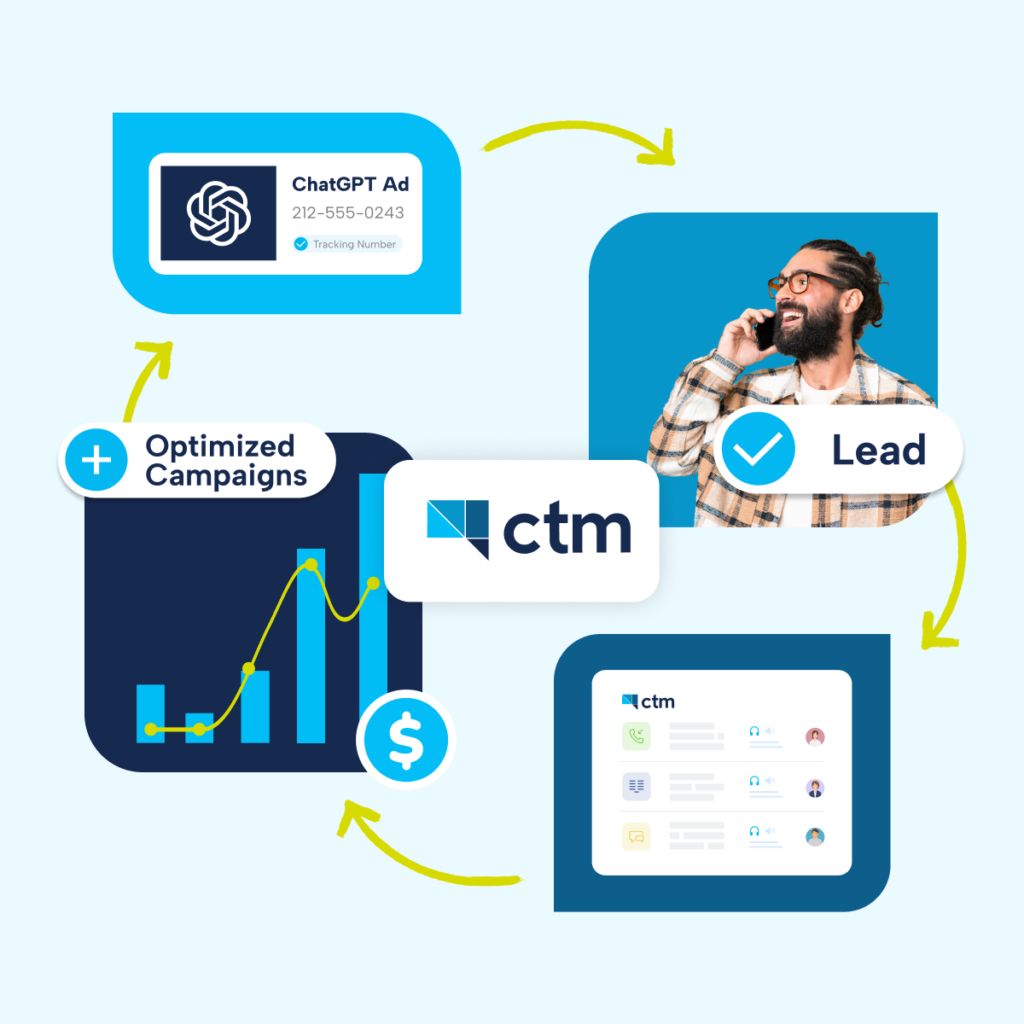
CTM offers native attribution and conversion tracking for OpenAI Ads. When your ChatGPT campaigns generate calls and leads, CTM connects them back to the specific campaigns that drove them, so OpenAI-sourced activity shows up right alongside your other channels in CTM reporting. From there, CTM sends qualified conversion events back to OpenAI, giving the platform the downstream signal it needs to optimize toward your best outcomes.
For agencies, that means clean, defensible reporting for clients investing in AI advertising. For performance marketers and enterprise teams, it means OpenAI Ads finally measures like the rest of your stack: by campaign, by lead quality, and by revenue influenced. And because it builds on the same attribution and conversion workflows CTM already runs for Google Ads, Microsoft Ads, Meta, LinkedIn, and more, there’s no new measurement philosophy to learn, just a new channel brought into the fold.
The Bottom Line
The AI advertising era rewards marketers who can prove what’s working. New channels will keep emerging, and the ones who treat attribution as a core capability, not an afterthought, will be the ones confidently scaling spend while everyone else is still guessing.
OpenAI Ads is the channel. Attribution is the strategy. CTM connects the two.
Ready to bring your OpenAI Ads campaigns into focus? Request a demo to witness attribution for the AI era in action.